A combustible dust is any finely divided material that will ignite and propagate a flame front when suspended in air at the right concentration. The list is longer than most people expect, and a good deal of it is food.
- Food and agricultural — flour, sugar, starch, grain, rice, potato, powdered milk, dried egg.
- Metals — aluminium, magnesium, zinc, bronze and their grinding and machining fines.
- Fuels and chemicals — coal, sulphur, and a long list of process intermediates.
- Organics — wood, textiles, rubber, plastics, paper.
- Pharmaceutical and agricultural chemicals — active powders and pesticides.
The hazard has a well-understood shape. A primary event — often small — disturbs settled dust elsewhere in the building; that dust goes into suspension and provides fuel for a second, far larger event. Which is why removing accumulated layers is not housekeeping. It is the control measure.
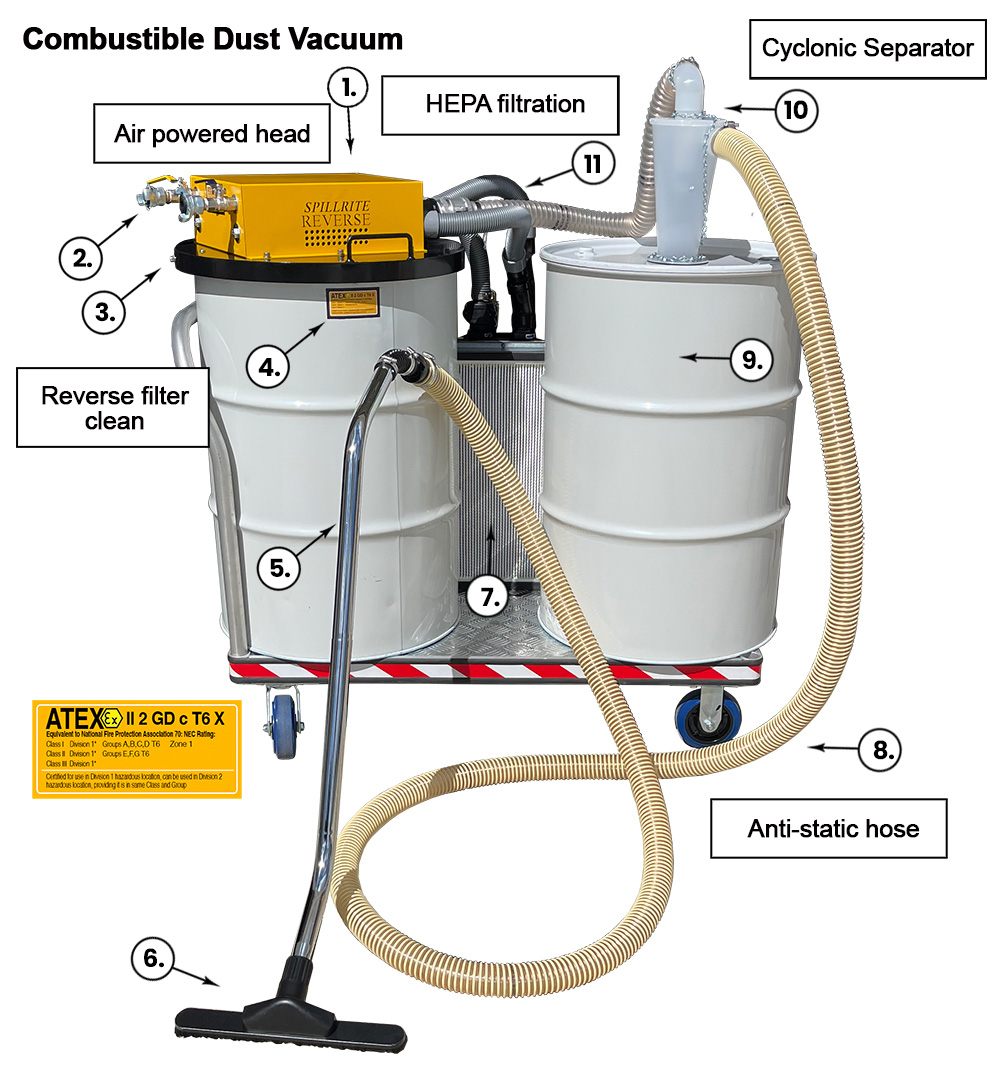
Why cyclone separation changes the job
A filter-only dust vacuum has a short working life between interruptions. Fine dust blinds the cartridge, airflow drops, and the operator stops to clear it — which is both a productivity problem and an exposure problem, because clearing a loaded filter by hand puts the dust straight back into the air.
A cyclone drops the bulk of the material out by inertia before it ever reaches the media. The filter then handles only the fines, and the collected dust ends up in a drum that can be sealed and removed without opening the machine.
Add reverse filter cleaning and the remaining limit goes too. Compressed air is driven back through the cartridge from the clean side, lifting the cake off the media in place. On the reverse-filter-clean drum top units this is a valve position, not a maintenance task.


Proven on the worst of it
The reverse-filter-clean units have done long service in Australian coal-fired generation — Eraring and Millmerran among them — on fly ash and coal dust. Abrasive blast media is the other duty that appears repeatedly. It carries no explosion risk at all, but it produces dust volumes that stop machines which cannot clear their own filters, which is why it ends up specified on the same equipment.

Mine sites and heavy industry
Mine sites take these units for two reasons at once. The obvious one is the explosion risk in coal and in some ore dusts. The less obvious one is that a compressed-air machine has no electrical approval to obtain, no cable to manage in a wet environment and nothing to trip — it is simply a hose and an air line.
| Pre-separation | Anti-static resin cyclone with integrated grounding chain |
|---|---|
| Filtration | Anti-static cartridge standard; H-class HEPA on exhaust optional |
| Filter cleaning | Reverse filter clean from the control valve, no dismantling |
| Capture | 60 litre stainless tank, or 205 litre drum under the cyclone |
| Airflow | 75 CFM through to 260 CFM depending on format |
| Certification | ATEX directive and UKCA EX |
| Format | Trolley-mounted, or drum-mounted head |
A broom in a dust-handling area does exactly what the hazard requires to escalate: it lifts settled material into suspension. If sweeping is still in your procedures for a classified area, that is usually the first thing an auditor questions and the easiest thing to fix.
Where the dust is also a respiratory hazard — silica, lead, hardwood, pharmaceutical actives — filtration grade matters as much as the explosion rating. That is covered under HEPA filtration.