Most industrial spills are not dramatic. They are the same coolant overflow, the same hydraulic weep and the same sump that has to be cleared every few weeks — jobs that get done with absorbent granules and a shovel because nobody has been given a better tool.
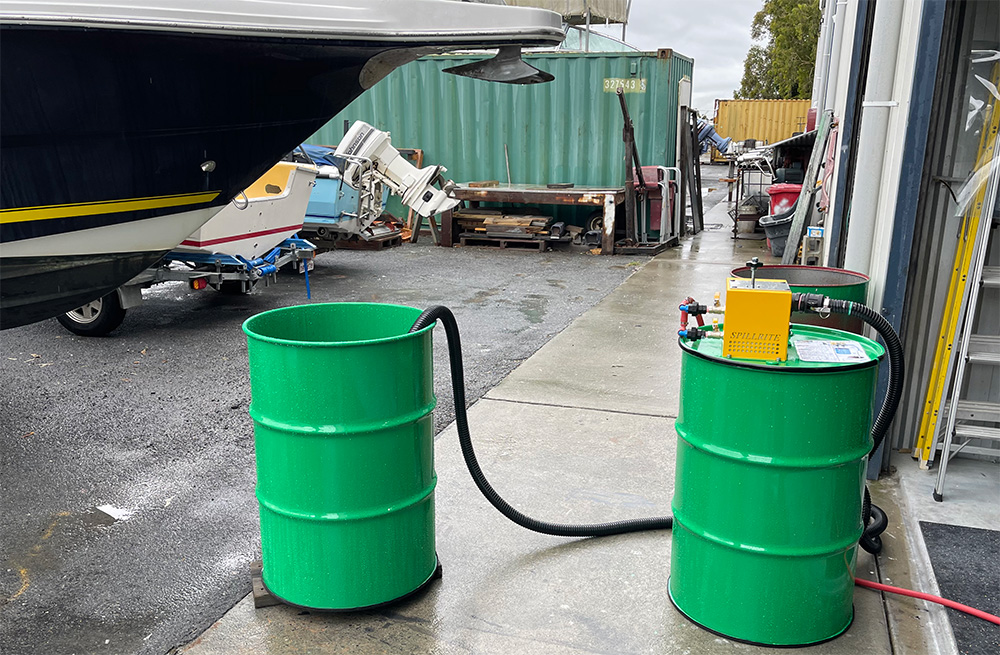
The better tool is an air-driven wet vacuum that recovers the fluid, holds it and then pumps it out where it needs to go. The recurring cost of granules and rags stops, the floor is actually clean rather than covered in used absorbent, and the waste ends up in a container the disposal contractor will take.
Flammable, combustible, or neither
Before anything else, the fluid has to be classified, because it determines the whole specification. The conventional dividing lines are:
- Flammable liquids — flash point below 37.8°C. Petrol, many solvents, thinners, some cleaners and adhesives.
- Combustible liquids — flash point at or above 37.8°C and below 93.3°C. Diesel, many oils, some paints.
- Everything else — water, most coolants, most washdown residues, mud and bilge.
It is worth being clear about what ignites. The liquid does not burn; the vapour above it does. That is why a small quantity of a low flash-point solvent in a poorly ventilated pit is a more serious proposition than a large quantity of oil in the open, and why an explosion proof unit is specified by the vapour risk rather than by the litres involved.
The explosion proof fluid unit
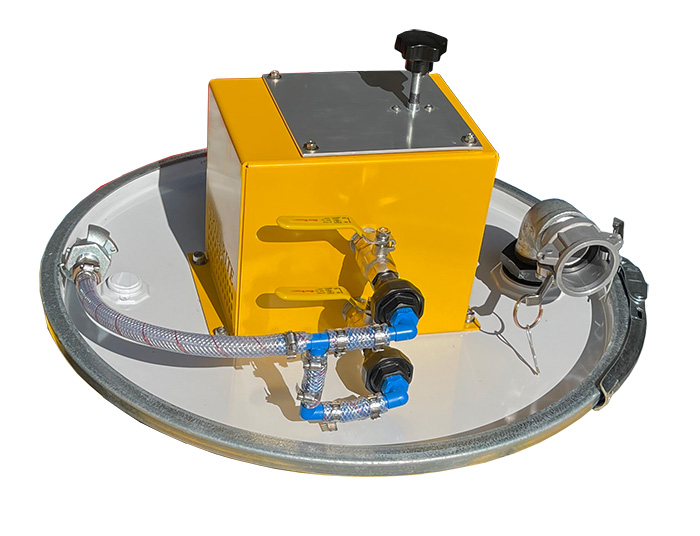
Where the fluid is flammable, the machine has to be built as one bonded assembly. The representative configuration is a 60 litre stainless capture tank under an anti-static powder-coated silencer shroud, on a mild steel lid, with the tank clipped to the lid and a grounding chain running from the front of the trolley to earth.
| Air supply required | 100 CFM minimum |
|---|---|
| Air fitting | 3/4" claw coupling with ball valve |
| Vacuum flow | Around 130 CFM |
| Vacuum rating | 17" Hg maximum |
| Capture tank | 60 litre stainless steel |
| Venturi | Twin reverse — vacuum and pump-out |
| Drum fill or pump out | Around 75 seconds |
| Maximum hose run | Around 17 m on 38 mm |
| Hose and tooling | EX smooth-bore anti-static hose, chrome wand, metal floor tool |
| Shut-off | Automatic fluid shut-off valves |
Thick fluids, solids in suspension
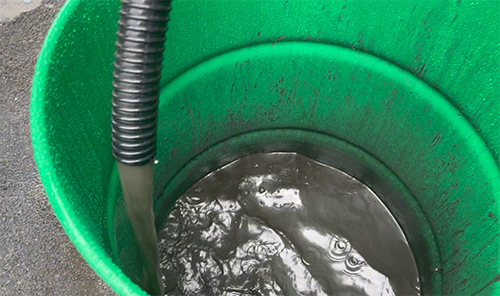
Light liquids are not the hard case. Sludge, grease, mud and fluid carrying suspended solids are, because they will not flow up a hose on vacuum alone at any useful rate. Reverse pump-out handles them the other way round: the drum is pressurised and the material is pushed out through the drop pipe, which shifts material that no amount of suction will move at the delivery end.
- Waste oil, sump oil and hydraulic residue.
- Machine coolant, including the sludge layer at the bottom of the sump.
- Bilge water, salt water and deck washings.
- Mud, drilling residue and slurry with solids in suspension.
- Greases and viscous process residues.
- Fuels and solvents — on the explosion proof configuration only.

A certified head on a standard hose with plastic tooling is not a certified system. When you quote an explosion proof fluid unit, quote the hose, wand, floor tool, fittings and tank together — and replace consumables with the same specification later.