Recovering a spill is only half a job. The drum still has to be emptied, and on most sites that means a forklift, a pump borrowed from somewhere else, or two people tipping a full drum. A two-way unit removes that step: the machine that filled the drum empties it.
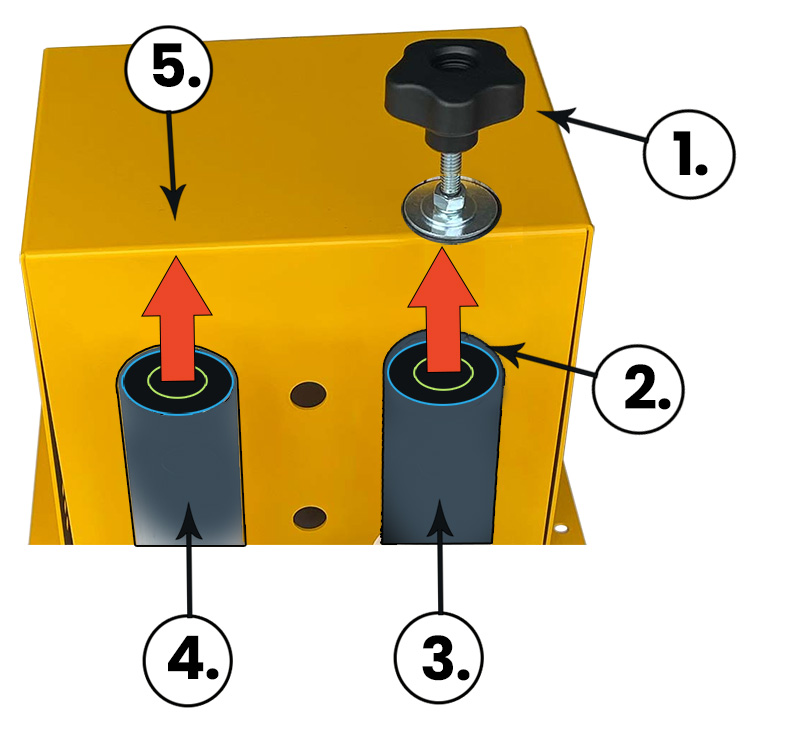
The mechanism is simple enough to trust. The head carries two venturis. In vacuum mode both run and exhaust to atmosphere. Screw the handle down and one exhaust is blocked; open the second control valve and compressed air is redirected into the drum through reverse jets. Pressure builds inside the drum, and the only way out for the fluid is up the drop pipe and out through the suction hose — now running the other way.
Why it does not over-pressurise
The obvious objection to pressurising a drum is that drums are not pressure vessels. The design answers it passively. The second venturi is left permanently open, so air can always escape through its throat and out the exhaust. Internal pressure is bled off as fast as it is created, capped on the larger units at around 8 psig.
There is no spring, no relief valve and no diaphragm in that path — nothing that can stick, corrode or be adjusted out of specification by a well-meaning fitter. That is the reason reverse pump-out is offered on certified explosion-proof units at all.
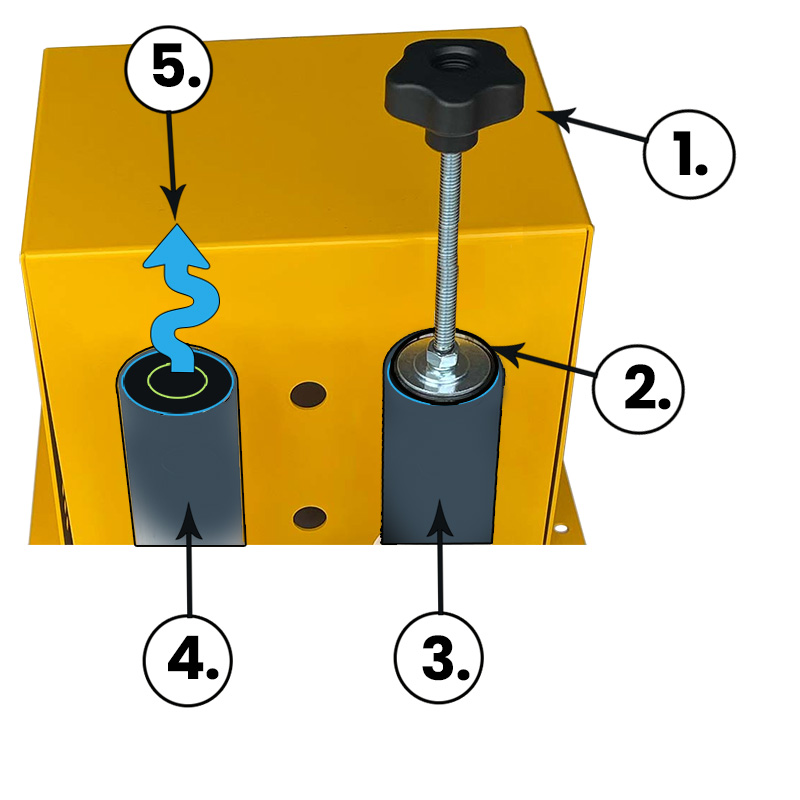
What the operator actually does
- To vacuum: handle fully up, both control valves closed, air connected at the claw coupling. Open the vacuum valve and work.
- Wet work: fit the float valves. As the fluid rises they lift and shut the vacuum off, even with air still supplied — the drum cannot be overfilled.
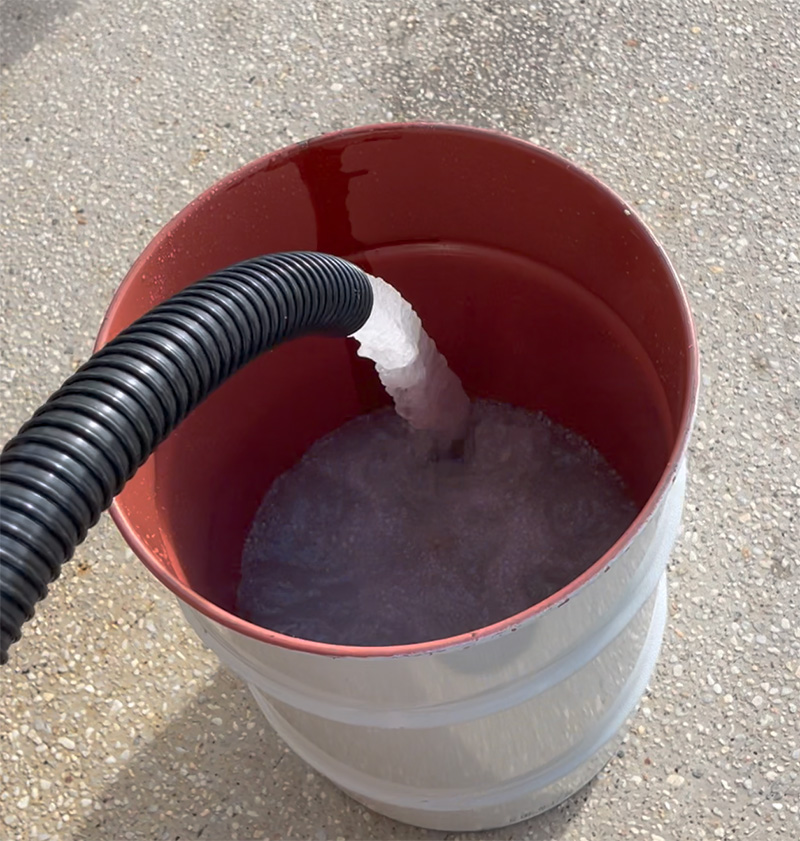
- To pump out: fit the internal drop pipe, move the suction hose to the delivery point, close the vacuum valve, screw the handle down, open the reverse valve.
- Dry work: fit the dry filter cartridge instead of the floats. On units with reverse filter cleaning, the same handle-down position drives air back through the cartridge to clear it.
Two sizes of the same idea
The two-way principle is offered in a compact pump-head format and in a full drum-lid format. The pump heads are the entry point — they screw into the bungs of a drum you already own.
| 20 CFM — standard | 32 mm hose and tooling, poly reducing bush, Nitto control valves |
|---|---|
| 40 CFM — explosion proof | 38 mm anti-static hose, all-metal fittings, steel reducing bush, grounding strap |
| Drum fill or empty time | Around 90 seconds for a 200 litre drum, both sizes |
| Shut-off | Chrome float valve, automatic as the drum fills |
| Pump-out | Internal drop pipe, delivery through the suction hose |
| Exhaust | Vented downward inside the silencer, away from the operator |
| Warranty | 5 years |
Step up to a drum lid unit and the whole lid is replaced rather than the bungs used, which buys a much larger intake, a filter cartridge for dry work and airflow up to 180 CFM and beyond. Those are covered under drum lid vacs.

Typical duties
- Sump and pit clean-outs where the waste has to go to a bulk container, not stay on the floor.
- Coolant recovery around machining centres — out of the sump, into a drum, out again to the filtration rig.
- Bilge and deck spills on vessels and rigs, where lifting a full drum is the hazard.
- Waste oil and grease collection in workshops and plant rooms.
- Mud, slurry and washdown residue with solids suspended in the fluid.
The standard machine handles most non-flammable fluids. If the fluid is flammable or the area is classified, the explosion proof version is the one to quote — anti-static hose, metal fittings throughout and a grounding strap, certified as an assembly.