Most workshops are running a domestic wet-and-dry vacuum well beyond what it was built for. It copes with sawdust and loses the argument with swarf, coolant and blast media — usually by burning out a motor somewhere in the second year.
The workshop range here is the same air-driven engineering used in classified areas, specified without the certification premium for shops that do not need it. If the compressor is already running, the vacuum has nothing left to buy: no motor, no power lead, no duty cycle, and nothing to replace when it has been running all afternoon.
Why air suits a workshop
- No motor to kill. Coolant mist, fine metal dust and continuous running are what destroy electric shop vacuums. None of them touch a venturi.
- No duty cycle. The machine runs as long as the air lasts. There is no thermal cut-out and nothing to let cool.
- Suction that does not fade. A venturi that is clear performs the same in year ten as on day one.
- No electrics in a wet bay. Washdown areas, oil bays and outdoor work are all ordinary duty.
- Service is a spanner. Three bolts release the shroud; the baffles wash in soapy water and go back dry.

Choosing a format
Three formats cover almost every shop, and the choice is mostly about what you already have on the floor.
| Drum top head | Sits on a drum you already own. Cheapest capacity, easiest to store |
|---|---|
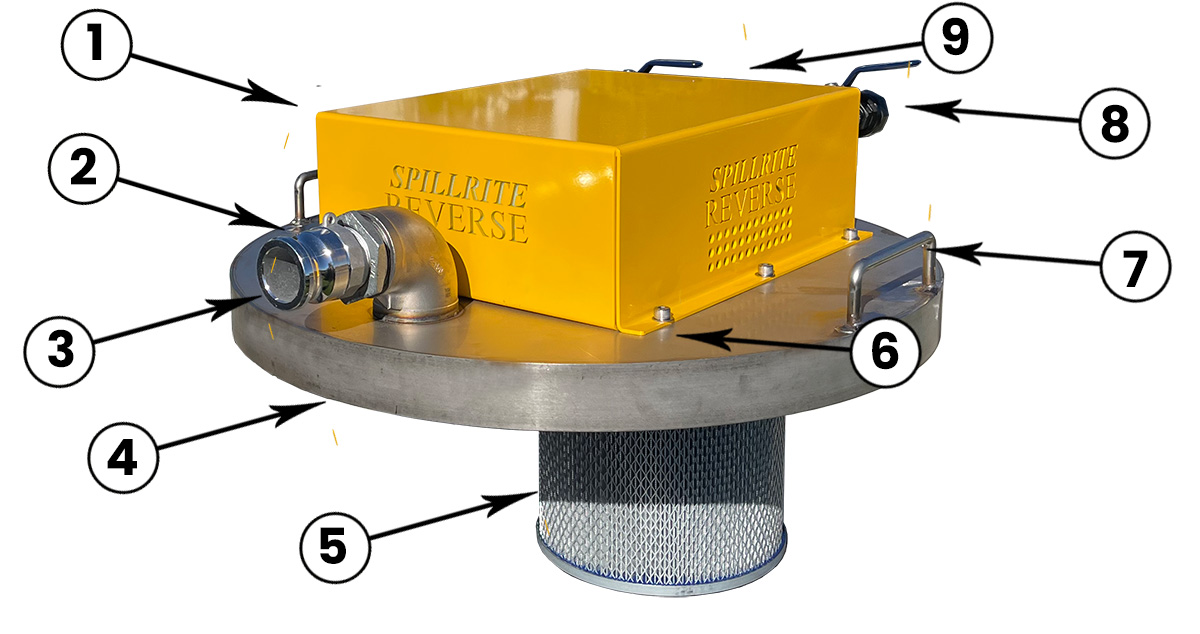
| Drum lid assembly | Replaces the lid. Larger intake, dry filter, reverse pump-out |
| Bung-mounted drum pump | Smallest and lowest air demand. Sump oil, coolant, grease |
| Hose | 38 mm (1½") for general work, 50 mm (2") for bulk and heavy solids |
| Wet duty | Float shut-off, so the drum cannot be overfilled |
| Dry duty | Large cartridge filter, reverse-clean option |
| Warranty | 5 years |

The jobs it gets bought for
- Swarf and machining debris — steel, alloy and brass fines around lathes and mills.
- Coolant sumps — pump the sump down, clear the sludge, put clean coolant back.
- Blast media recovery — abrasive, heavy and merciless on an electric machine.
- Oil and grease — service bays, plant rooms and anywhere a drip tray gets emptied.
- Washdown and trench work — wet floors, pits and drain channels.
- Grinding and welding dust — including the settled layer nobody reaches.
The commercial argument most workshops end up making is about consumables rather than the machine: absorbent granules and rags are a permanent line item, and recovering fluid directly into a drum removes it.

A standard workshop head can be moved to explosion proof specification later — anti-static filter, metal fittings, anti-static hose and a bonded assembly. If there is any chance the machine will be asked to work in a classified area down the track, mention it now and we will note the configuration.
If part of the shop is classified — a paint booth, a fuel bay, a powder handling area — specify that work separately under hazardous zones rather than trying to make one machine cover both.