“Explosion proof” is a misleading phrase in general use. It does not mean the machine survives an explosion. It means the machine has been engineered so that it cannot be the thing that starts one.
There are only two ways a vacuum ignites an atmosphere: it produces a spark or enough heat to reach an ignition temperature, or it lets static electricity accumulate until the charge jumps a gap. Removing the first is a matter of how the machine is powered. Removing the second is a matter of how it is assembled — and it is the half that gets neglected.
Power without an ignition source
Suction is produced by venturi. Compressed air accelerates through a restriction, static pressure falls, and that drop becomes the vacuum at the intake. The entire power section therefore consists of fixed passages with air moving through them.
- No rotating element, so no friction and no bearing to run hot.
- No electrical circuit, so no arcing at a switch, a contact or a motor winding.
- No heating element and no thermal cut-out to reach a surface temperature that matters.
- Nothing that wears in a way that changes performance — a venturi that is clear pulls the same vacuum years later.
Power is scaled by adding venturis rather than by increasing motor size. The range runs from compact units up to configurations consuming around 300 CFM of compressed air for the heaviest continuous work.
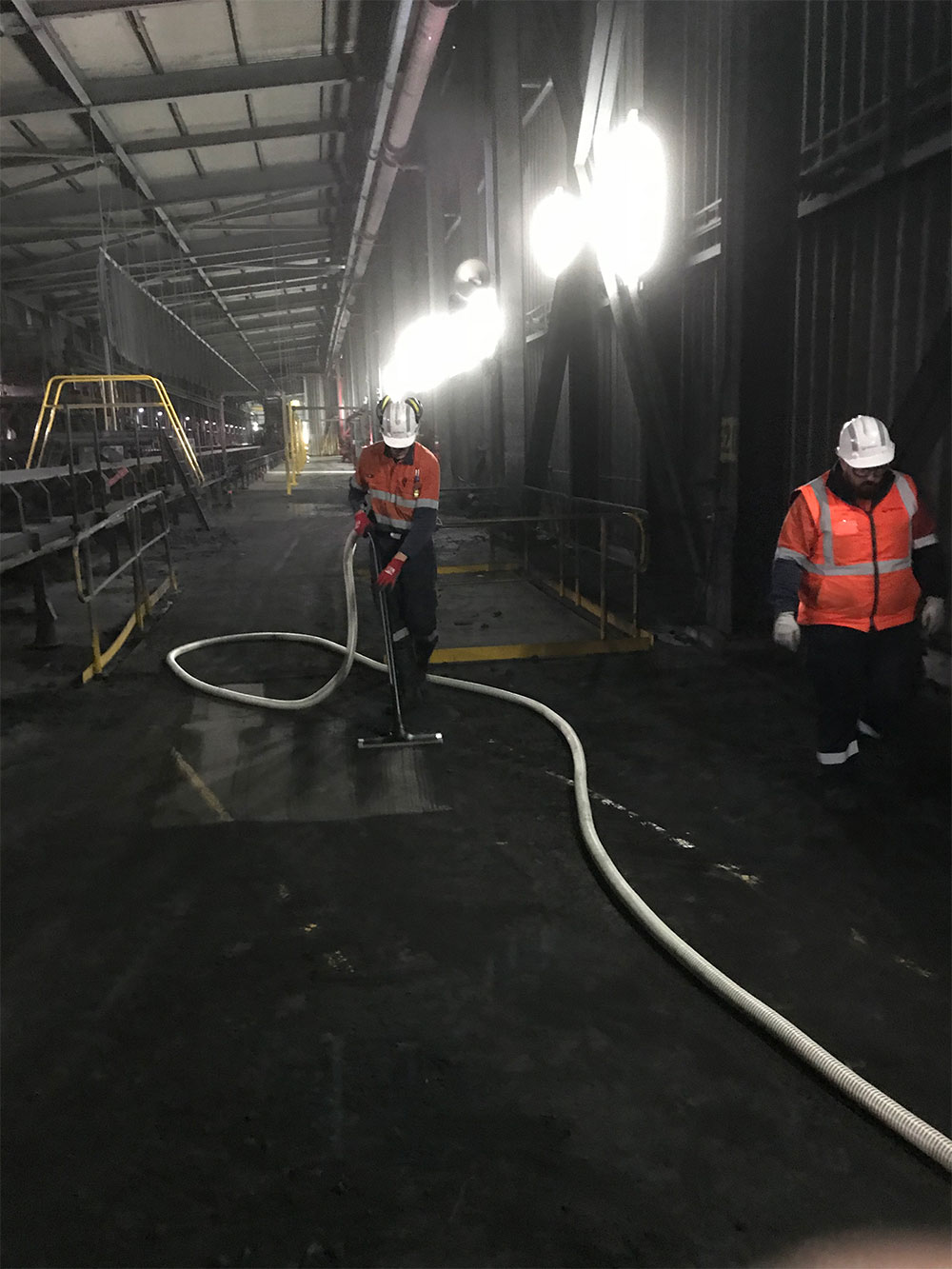
The static path is the real engineering
Charge is generated by the process itself: powder moving through a hose at speed strips electrons off the wall. In a well-built anti-static system that charge is continuously bled to earth. In a poorly built one it collects on an isolated component until it finds a path, and the path it finds is a spark.
A complete assembly is therefore a single conductive body from the tool at the operator’s hand to the earth point:
- Cyclone in anti-static resin, with its own chain tying it into the circuit.
- Anti-static suction hose with the helix wire exposed and clamped against the wand or camlock at each end — usually marked with red tape.
- Metal intake fittings, wands and floor tools, not plastic substitutes.
- Steel or stainless capture tank, with metal fittings tying tank to head.
- Metal trolley or bonded drum, carrying a grounding chain or strap to earth.
- Anti-static filter media on the power head, where dry dust concentrates.

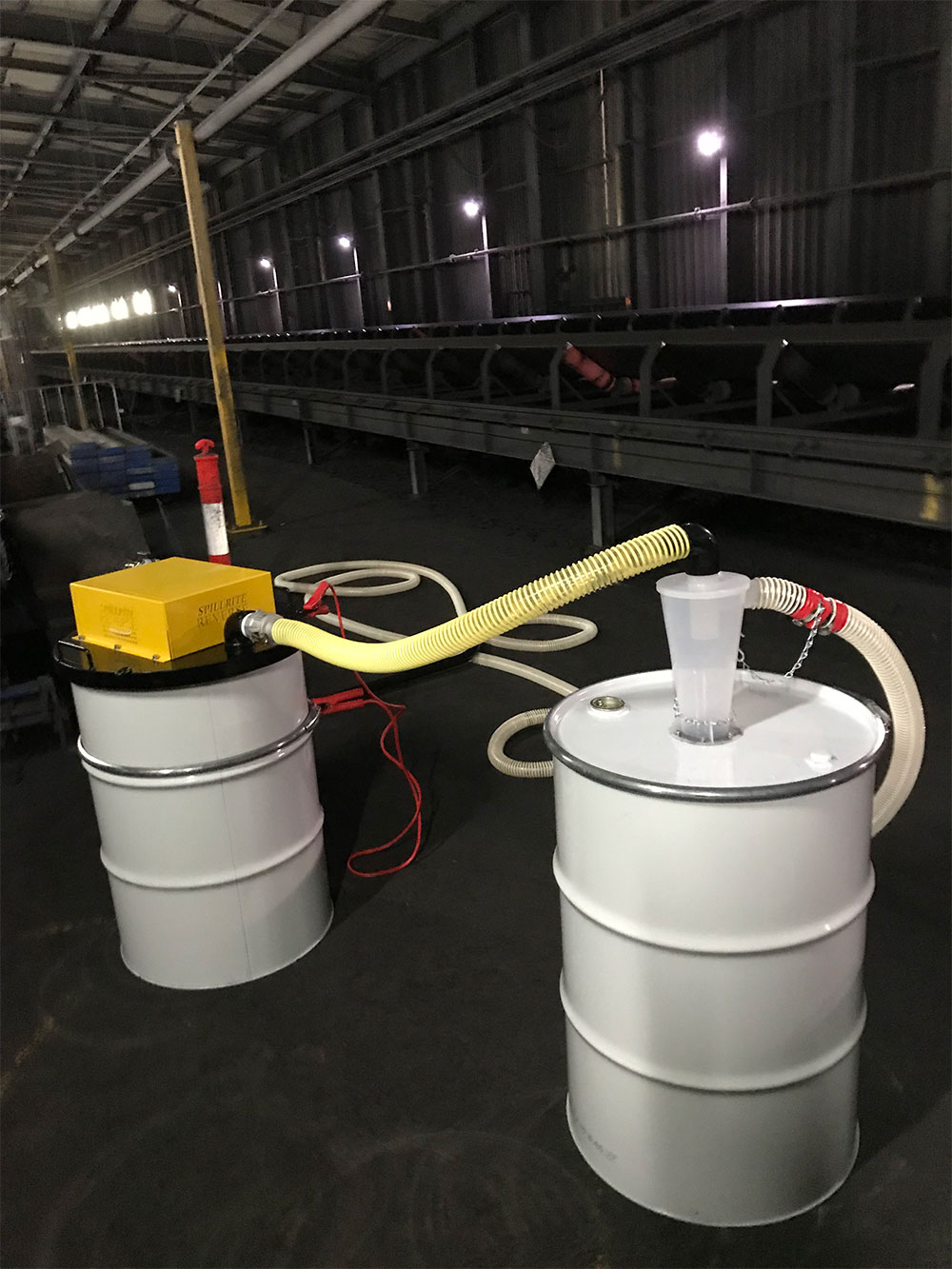
Drum-mounted units and the lock ring
On a drum lid vacuum the drum itself is part of the safety system. The pneumatic head bolts to a steel lid; when the lock band is closed, lid and drum are clamped into electrical contact and become a single earthed body. A wire across the internal gasket keeps that connection honest where the seal would otherwise insulate the two.
Two practical consequences follow, and both are worth passing to whoever will operate the unit. The drum has to be steel, and it has to be able to reach earth — a drum standing on rubber matting, a pallet or a bed of the waste it is collecting is not grounded, whatever the label on the head says.
On two-way units the venturi design limits pressure inside the drum: excess air escapes through the venturi throat and out the exhaust rather than being held. It is a passive arrangement with no spring or mechanical valve to fail, which is why reverse pump-out is available on certified machines at all.
Where explosion proof units are specified
- Oil and gas — production, refining, storage and distribution.
- Coal-fired generation — coal dust, fly ash and the associated ash handling plant.
- Mining — surface and underground, both for combustible dust and for diesel-free requirements.
- Grain, flour and food powder — where the product itself is the explosive dust.
- Chemical and pharmaceutical — solvent vapour and fine active powders.
- Defence, aerospace and marine — propellants, fuels and confined spaces.

If you need the certification marking for an audit, see ATEX certified. If your hazard is settled and airborne powder specifically, combustible dusts covers the cyclone and filter arrangements that suit it.